
Reviewed · SEVILLE BIKE TOURS
Seville: Historic Center Bike Tour
Seville’s old defensive route is the real star of this bike tour. Instead of simply ticking off famous buildings, you follow the city’s former walls and gates, where Roman origins, Almoravid power, royal processions, and the riots of 1868 all meet. I especially like the route through Macarena and Puerta de Córdoba, plus the stops at Puerta Carmona, Puerta Osario, and Puerta Triana. You get a useful map of Seville’s past while moving through its present-day streets.
The $35 price is fair for 2.5 hours, a bicycle, a guide, water, and a map. I also like that guides such as Luca, Daniel, and Sébastien have earned strong praise for clear explanations and careful attention, including language help when needed. The main caution is the equipment: one participant found the bicycles near the end of their useful life, so this is a history tour first and a polished cycling experience second.
Key points about Seville’s old-wall bike route
- The former defensive walls: Follow surviving sections connected to Seville’s medieval defenses and learn why the Almoravids made the city one of Europe’s best-walled cities.
- Macarena and Puerta de Córdoba: See important remains of the old fortifications and connect them to Seville’s medieval past.
- Three historic gates: Puerta Carmona, Puerta Osario, and Puerta Triana each open a door to stories about carriages, city movement, and local mysteries.
- A long view of Seville’s past: The guide links Tartessians, Carthaginians, Romans, medieval rulers, and the 1868 upheavals.
- Multilingual guiding: Tours are offered in Spanish, English, and French, with Luca also praised for speaking French, Italian, and Spanish.
- Good value for active sightseers: The tour combines transport around the center with history, rather than charging separately for a sightseeing ride and a museum visit.
Why the old walls make this bike tour different
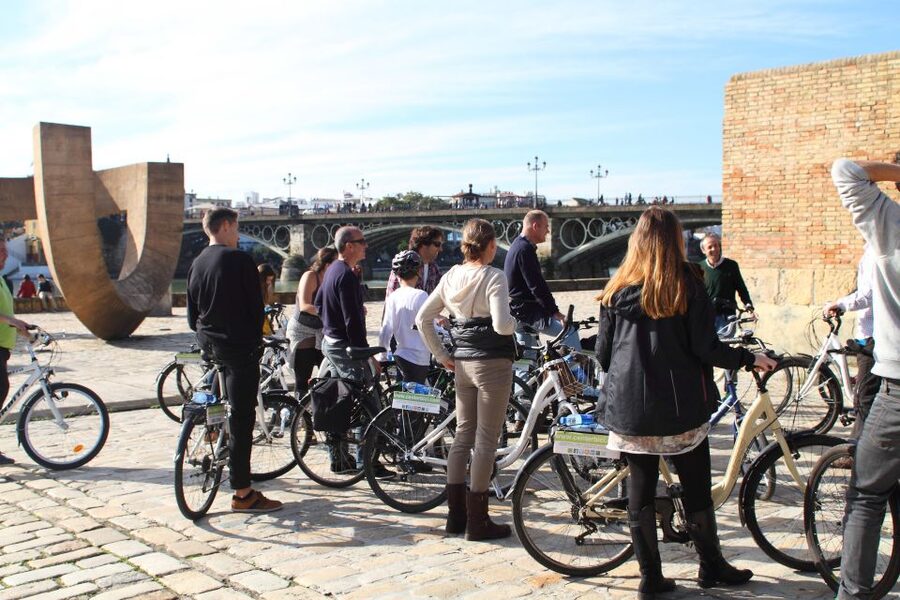
Many city bike tours give you a fast look at major monuments. This one has a clearer theme: Seville as a fortified city. That focus gives the ride shape and helps you understand why gates and fragments of wall appear in places that might otherwise seem like unrelated bits of masonry.
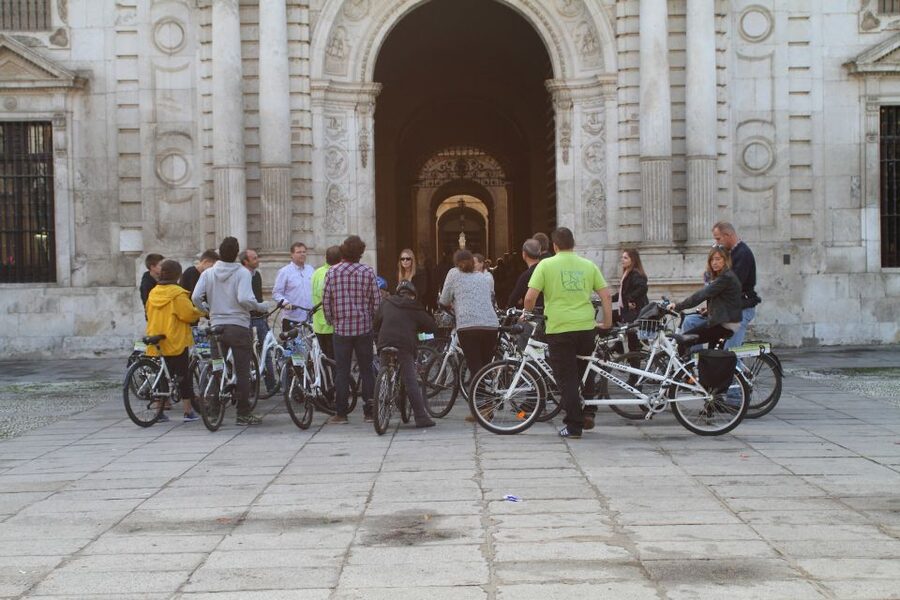
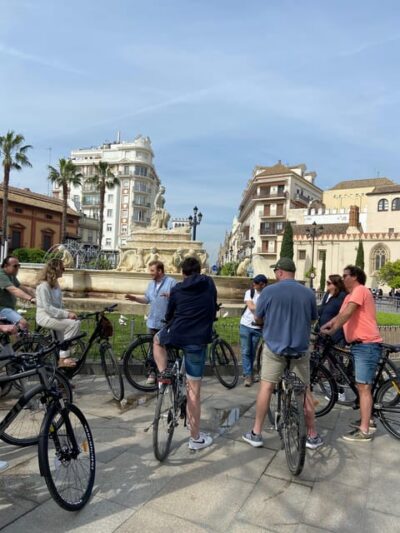
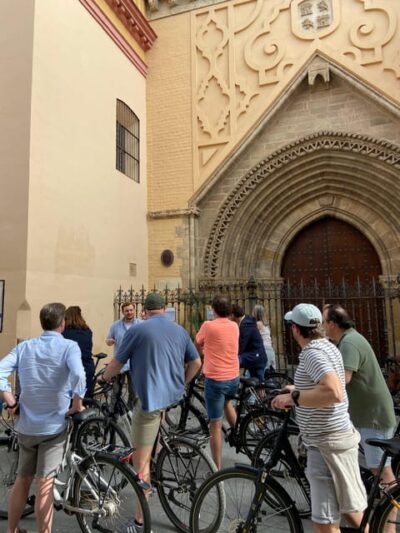
The tour begins at Centerbici Store on C/ Espronceda, 5, in central Seville. From there, you meet your guide, collect a bicycle, and set off through the historic center. The exact order of stops may vary, but the route centers on the old defensive line and several former gates.
I like this approach because walls tell a different story from palaces and churches. A grand building shows you how a city wanted to present itself. A wall shows what it feared, whom it needed to keep out, and how tightly it controlled movement. At each gate, you can picture the old city as a place with clear edges, not the broad urban area you see today.
The tour also gives you a useful timeline. Seville’s story reaches back to the Tartessians and Carthaginians, then to Roman settlement and later medieval rule. You will not get a full university course in 2.5 hours, but the guide can show how each period helped shape the city you are riding through.
More Seville Bike Tours:
- Seville Highlights Bike Tour (English)
★ 5.0 · 2,225 reviews - Seville: Highlights City Bike Tour
★ 4.8 · 2,168 reviews - Seville: Relaxing City Bike Tour with a Tour Guide
★ 4.8 · 1,588 reviews
Macarena and Puerta de Córdoba: Seville behind its walls
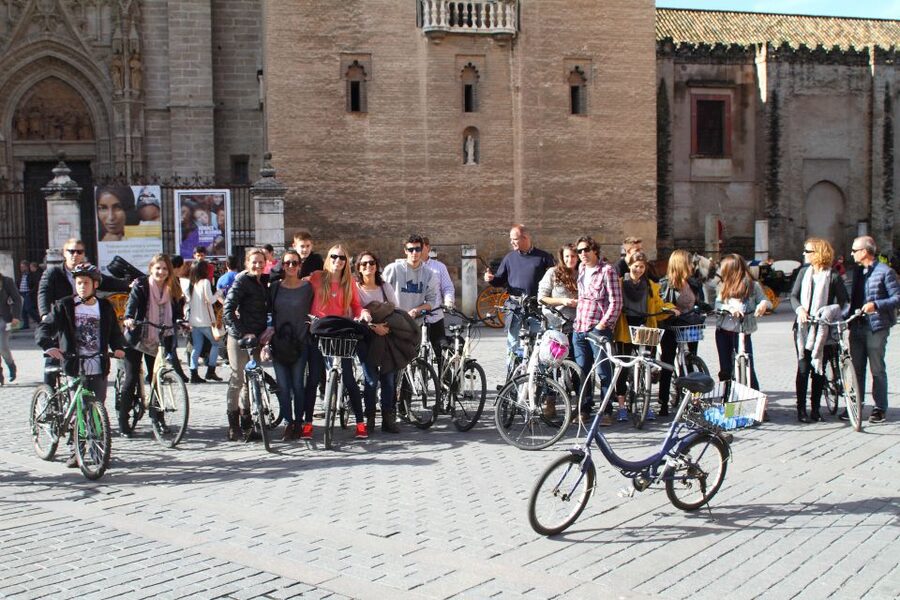
Macarena is one of the key areas on the route. Here, you see sections of the old wall and learn about Seville’s defenses under the Almoravids. The tour presents medieval Seville as one of Europe’s best-walled cities, a useful piece of context when you look at the remains beside modern streets.
Puerta de Córdoba adds another important stop. The name itself tells you what these gates did: they controlled entry and linked the city to routes beyond its walls. The physical remains are not a complete medieval fortress, so set your expectations properly. You are seeing surviving sections and historic structures within a living city, not entering an untouched walled town.
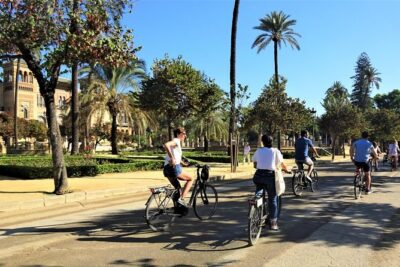
That is also what makes the bicycle useful. You cover more of the defensive route than you would comfortably manage on foot, while still stopping often enough for an explanation. The bike saves energy between points of interest, but you should expect a sightseeing pace rather than a sporty ride.
The route connects the walls with Seville’s wider architectural mix. As you move through the center, the guide points out different styles and explains how the city changed over time. The value is in seeing those changes in sequence, not in examining one monument for a long period.
Puerta Carmona and the stories at the city gates
Puerta Carmona is one of the tour’s more story-driven stops. The old gates were practical control points, but they also gathered people, traffic, gossip, and suspicion. Here, the guide explains how carriages were stopped and how stories and mysteries grew around the movement of people through the city.
You will not spend the whole tour listening to abstract dates. The best parts connect history with ordinary actions: who could enter, how vehicles were checked, and what happened when the gates closed. These details make Seville’s past easier to picture.
Puerta Osario adds another piece to that route. Together, Puerta Carmona and Puerta Osario help you understand that the wall was not just a single barrier. It was a network of controlled openings, each tied to a direction, a road, or a part of city life.
The stops also give you natural chances to look at the architecture. Seville’s historic center is not built in one style, and the tour uses that variety to explain the city rather than treating buildings as isolated photo stops. If you enjoy urban history, this is more useful than a route that only points toward famous façades.
Puerta Triana and the western side of historic Seville
Puerta Triana brings the route to another important entrance. The guide uses the gate to explain how people and carriages moved through Seville and how the city’s boundaries shaped daily life.
The tour’s mention of Triana is especially helpful because the name carries strong associations in Seville, but the focus here is the gate and the old defensive system. You are not promised a long independent visit to every district or monument. This is a connected ride through historic points, with the former wall as the thread.
At Puerta Triana, listen for how the guide links city access with political and social change. A gate can look modest today, but it once helped decide who entered, who left, and how goods and people passed through. That practical history is one of the strongest reasons to choose this tour.
The route also includes surviving sections connected with the Alcázar. The old royal complex is one of Seville’s major historic areas, and the wall remains help place it within the city’s defensive system. You should not expect an interior visit to the Alcázar as part of this activity. The bicycle tour gives you an outside view and historical context.
More Historical Tours in Seville:
- Sevilla Food Tour: Tapas, Wine, History & Traditions
★ 5.0 · 3,468 reviews - Ultimate Seville Tapas, Wine & History Small Group Tour
★ 5.0 · 1,766 reviews - Seville: Tapas, Taverns, and History Walking Tour
★ 4.9 · 676 reviews - Seville Evening Historical Tour with Haunted History
★ 5.0 · 626 reviews
From Roman origins to the 1868 upheavals
The historical range is wide. Your guide discusses the Tartessians and Carthaginians, then explains the Roman presence and Seville’s later development as one of Spain’s major cities. These early periods are presented as part of a long story rather than as separate trivia.
The medieval section receives particular attention because of the walls. You learn how Seville became heavily fortified under the Almoravids and why the city’s defensive system mattered. This is where the route’s theme pays off: the history is being explained at the very structures built for that purpose.
The tour also reaches the riots of 1868 and the Glorious Revolution. Those events mark a later period when political change affected the city and parts of the old defenses were lost. The remains at Macarena, Puerta de Córdoba, and around the Alcázar take on added meaning because you learn what survived and what disappeared.
I appreciate this final layer. A wall is not only medieval. Later city growth, political unrest, and changing ideas about urban space can damage or remove historic structures. The tour helps you see Seville as a city that kept changing, not as a museum frozen in one century.
What the guides add to the ride
The guide can make or break a history ride, and this experience depends heavily on that person. Luca has been praised for detailed explanations, strong French, Italian, and Spanish, and close attention to the comfort of the group. Daniel and Sébastien have also received specific praise for their guiding.
Language support is available in Spanish, English, and French. One French-speaking participant needed the tour in French, but the guide explained the material in English and used phone translation when necessary. That suggests a practical attitude, though you should confirm your preferred language when booking if it matters to you.
The guide’s role is not limited to leading the bicycles. You will rely on that person to explain what remains of the wall, connect distant historical periods, and point out why each gate mattered. A good guide turns a short stop at a stone structure into a scene from the city’s past.
The experience seems best suited to people who enjoy asking questions and following a historical thread. If you want a quiet, independent ride with no commentary, this may feel too guided. If you want context without spending hours inside a museum, the format works well.
Bicycle quality, pace, and comfort
A bicycle tour sounds effortless, but the equipment matters. Bicycle rental is included, along with a water bottle and map. Helmet rental is listed for children. One participant found the bicycles somewhat worn, with no serious problem, but that is worth noting before you book.
I would treat the bicycle as a practical way to connect the stops, not as a premium cycling product. The stated duration is 2.5 hours, long enough to cover substantial ground but short enough to fit into a busy Seville itinerary. The tour is not designed for people seeking speed, distance, or demanding exercise.
You should be comfortable riding in an urban historic center. The activity is not suitable for people with mobility impairments. The supplied details do not specify the group size, bicycle model, or exact riding conditions, so ask the provider if those points affect your decision.
The water bottle is a small but useful inclusion, especially when you are cycling and stopping in the open air. The map also helps you keep track of the route after the tour, giving you a better sense of where the old gates fit within modern Seville.
Is $35 a fair price for 2.5 hours?
At $35 per person, the cost is reasonable if you value both transportation and guiding. You receive a bicycle, a live guide, water, and a map, while covering several historic points that would take more effort to connect on foot.
The price is strongest for a first or second day in Seville. You get your bearings around the historic center and learn the basic shape of the city before returning to places that interest you. The tour may also save you from booking a separate orientation walk and a separate bicycle rental.
The value is less clear if you want long visits inside major monuments. This is not an Alcázar admission, a church tour, or a museum visit. Its value comes from the route, the explanations, and the way the wall and gates connect the city’s history.
Flexible booking adds practical value. You can cancel up to 24 hours before the activity for a full refund, and you can reserve now while paying later. Starting times depend on availability, so check the schedule before building the rest of your day around it.
Who should book this Seville bike tour?
I would recommend it to active sightseers who want a clear introduction to Seville’s historic center. It suits you especially well if walls, gates, political change, and city planning interest you more than a simple list of famous buildings.
It is also a good fit if you are staying in Seville for a short time. The 2.5-hour format gives you a useful overview without taking a full day. French speakers should find the language options helpful, and the guide team has shown strong language flexibility.
Families with older children may appreciate the manageable length, the bicycle format, and the child helmet option. Still, you should judge your child’s comfort with cycling in a city before booking.
I would hesitate if you need fully accessible transport, want a guaranteed high-end bicycle, or prefer a slow walking tour with long stops. The old-wall theme is strong, but you will spend much of the time moving between places rather than entering them.
Should you book it?
Book this tour if you want to understand Seville as a fortified city, not just photograph its grandest monuments. The route through Macarena, Puerta de Córdoba, Puerta Carmona, Puerta Osario, Puerta Triana, and the Alcázar area gives the ride a clear purpose, while the stories of Roman settlement, Almoravid defenses, and the 1868 upheavals add useful depth.
The strongest reason to go is the guiding. Luca, Daniel, and Sébastien are names associated with careful, engaging explanations, and language support is a real strength. The only meaningful warning is the occasional report of tired bicycles. At $35, that is a reasonable compromise for an informative, active introduction to Seville’s old center.
FAQ
Where does the Seville Historic Center Bike Tour meet?
The meeting point is Centerbici Store at C/ Espronceda, 5, 41004 Seville.
How long does the bike tour last?
The tour lasts 2.5 hours.
What languages are available?
The live tour guide is available in Spanish, English, and French.
Is bicycle rental included?
Yes. Bicycle rental is included, along with a water bottle and a map.
Is the tour suitable for people with mobility impairments?
No. The activity is listed as unsuitable for people with mobility impairments.
Can I cancel the booking for a refund?
Yes. You can cancel up to 24 hours in advance for a full refund.
Just added around Seville
- The Villages of Andalusia: Full-Day Trip from Seville★ 4.8 · 19 reviews
- From Seville: White Villages Tour★ 5.0 · 9 reviews
- White Villages & Ronda 2-Days Trip & Overnight Stay★ 4.6 · 5 reviews
- Your Photo Story in Seville★ 5.0 · 16 reviews
- Triana Market Tapas Tour★ 4.9 · 12 reviews
- Seville: Guided visit of the Casa de Pilatos with entrance tickets★ 4.3 · 18 reviews
- Wine tourism, visit to a traditional winery and wine tasting★ 5.0 · 3 reviews
- Yoga at María Luisa Park in Seville★ 5.0 · 17 reviews
Seville Bike Tours, compared.
Browse the lists this tour appears in