
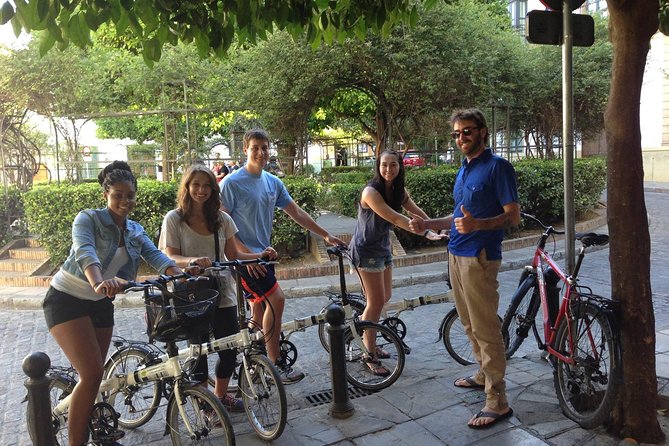
Reviewed · SEVILLE BIKE TOURS
Electric Bike Tour in Seville
Seville opens up beautifully on two wheels. In about three hours, you can roll from the leafy paths of María Luisa Park to the Guadalquivir river, cross into Triana, and pause near the Giralda, Cathedral, and Alcázar. The electric motor helps you keep moving without turning the ride into a workout.
I like two things right away: you cover far more ground than you could on foot, and the private format lets your group take breaks or adjust the route. Guides including Juan, Elena, Daniel, Ben, and Daniel have been praised for clear history and careful directions. The main caution is bike fit. The e-bikes can feel large for shorter riders, and a child around 58 inches tall was given a standard bike instead.
Quick points to know
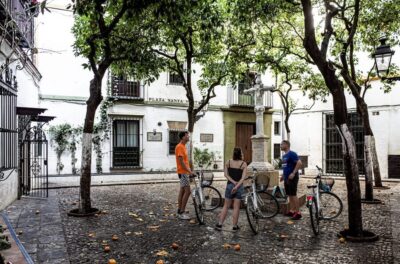
- Start at Plaza de Santa Cruz: The tour begins in Seville’s old quarter and returns to the same meeting point.
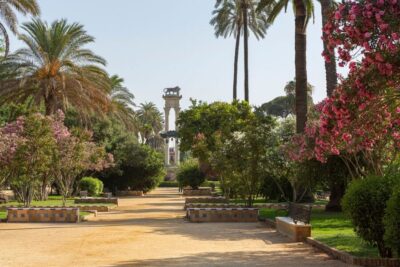
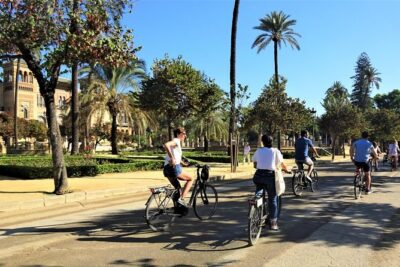
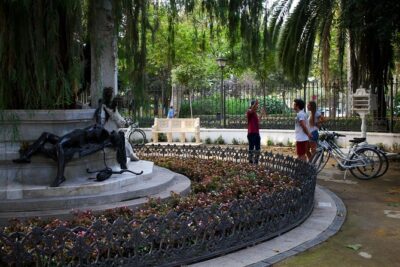
- Ride through María Luisa Park: Expect shaded avenues, gardens, fountains, ponds, birds, and the grand Plaza de España.
- Follow Seville’s river story: The route includes the Torre del Oro and Triana Bridge, two useful stops for understanding the city’s connection to the Guadalquivir.
- See major sights from outside: You pass the Giralda, Seville Cathedral, and the Royal Alcázar, but admission tickets are not included.
- Private and flexible: Only your group participates, with room for breaks and some choice about where to spend more time.
- Bring the right expectations: Water and helmets are supplied, but food, drinks, and hotel transfers are not.
Why an e-bike makes sense in Seville
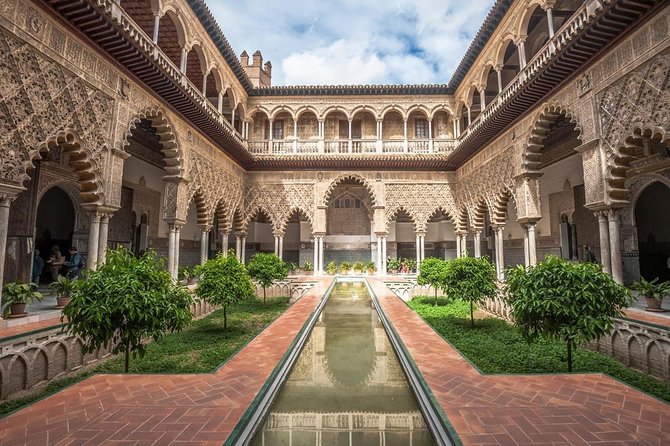
Seville is compact enough to explore on foot, but its sights are spread across several distinct areas. The Santa Cruz quarter, María Luisa Park, the riverfront, Triana, and the major monuments all fit together on a map, yet walking between them takes time and can feel tiring in warm weather.
An e-bike gives you a gentle push when you need it. You still pedal, but the motor helps on longer stretches and lets you arrive at the next stop without arriving worn out. Several people found the route easy enough that they did not need much electric assistance, but that is part of the appeal. You can use the boost when useful and coast along when the ride feels effortless.
This is not a fast cycling outing. The value is the mix of movement and explanation. You get a broad first look at Seville, then can return later to the places that deserve a longer visit.
The experience lasts about two and a half to three hours. That is long enough for a useful orientation without taking up an entire day. The tour is offered in English, though the guide may be multilingual.
More Seville Bike Tours:
- Seville Highlights Bike Tour (English)
★ 5.0 · 2,225 reviews - Seville: Highlights City Bike Tour
★ 4.8 · 2,168 reviews - Seville: Relaxing City Bike Tour with a Tour Guide
★ 4.8 · 1,588 reviews
Starting in Plaza de Santa Cruz
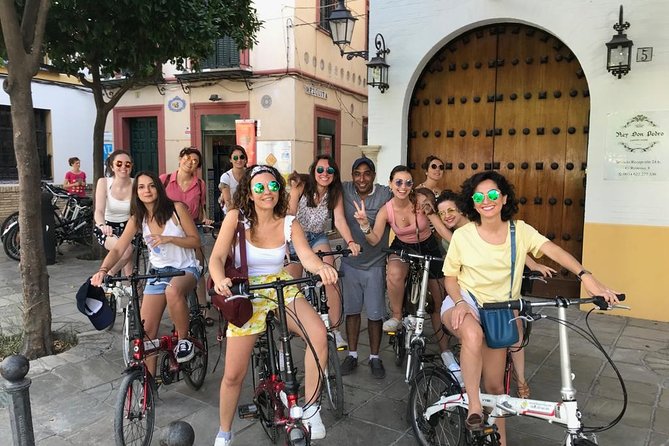
Your meeting point is Plaza de Santa Cruz, in the old quarter. This is a practical place to begin because you are already near Seville’s most famous monuments and the narrow streets of Santa Cruz.
The first moments matter. If you have not ridden an electric bicycle before, ask the guide to explain the controls before setting off. One person specifically wished the operation of the e-bike had been demonstrated more clearly at the start. A short explanation can prevent awkwardness in the first few minutes.
Check the bike size before you leave. Most adults should have no trouble, but shorter riders may find the frames tall or bulky. The experience includes a bicycle and helmet, yet the supplied information does not guarantee a specific frame size. If you are booking for a child, note that the child rate applies only when sharing with two paying adults, and one 10-year-old, about 58 inches tall, was too small for the e-bike and used a standard bicycle.
Once everyone is comfortable, the guide sets the pace. The best guides on this tour have been singled out for safety instructions, directions, and lively explanations. Daniel, Juan, Elena, Ben, and others have each received warm praise, though the guide assigned to your departure can vary.
María Luisa Park: Seville’s leafy pause
Parque de María Luisa is the tour’s most restful section. Much of the park began as the gardens of the Palace of San Telmo. In 1893, the Infanta Luisa Fernanda gave the grounds to Seville for public use. The park later became part of the preparations for the 1929 Ibero-American Exposition.
You ride through planted avenues and garden paths rather than simply circling a city block. Palms, orange trees, Mediterranean pines, fountains, ponds, tiled benches, and vine-covered bowers give the park a softer feel than the stone streets of the center. It also functions as a botanical garden, with native and exotic plant species marked by educational panels.
Allow about 30 minutes here. That is enough for a pleasant ride and some explanation, but not enough to explore every path or stop at every garden feature. If your group likes gardens, ask the guide to give this section a little more attention. The private format makes that request more realistic than it would be on a large shared excursion.
The park is also known for its many doves. That detail sounds small, but it helps you notice the place as a living public garden rather than only as a route between monuments.
Plaza de España and the 1929 exhibition
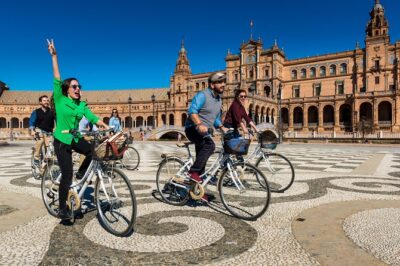
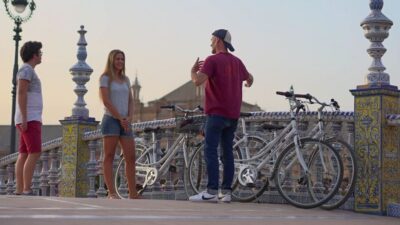
Within María Luisa Park, Plaza de España is the grand visual pause. Built in 1928 for the Ibero-American Exposition of 1929, it combines Baroque Revival, Renaissance Revival, and Neo-Mudéjar ideas in one sweeping complex.
You have about 10 minutes here, so think of the stop as an introduction rather than a full visit. Take in the curved building, tiled details, bridges, water, and open plaza. The design was made to impress, and it does so without much explanation.
This is one place where a bicycle tour has a clear limit. You can see the setting and hear the background, but you will not have time to study every ceramic panel or wander at length. If Plaza de España is high on your list, plan to return later on foot.
The short stop also keeps the tour moving. That matters because the route has several more major sights ahead.
A different sort of afternoon in Seville:
- Seville: Royal Alcázar Entry Ticket
★ 4.6 · 28,378 reviews - Seville: Cathedral and La Giralda Entry Ticket
★ 4.5 · 24,592 reviews - Seville: Live Flamenco Dancing Show Ticket at the Theater
★ 4.7 · 16,396 reviews - Seville: 1-Hour Guadalquivir River Sightseeing Eco Cruise
★ 4.2 · 10,281 reviews
Torre del Oro and Seville’s river entrance
The ride then reaches the Torre del Oro, the golden tower beside the Guadalquivir. The Almohads built the original dodecagonal section in the first third of the 13th century to control access to Seville by river. Its position makes the tower’s purpose easy to understand: this was a watchpoint guarding the city’s water entrance.
The name comes from the golden glow reflected on the river, linked to the tower’s building materials, a mixture of mortar, lime, and pressed hay. The structure changed over time. A second dodecagonal level was added in the 14th century, and the upper circular section was rebuilt in 1760 after damage from the 1755 Lisbon earthquake.
You do not need to enter the tower for this stop to work. From outside, the guide can connect the building to Seville’s military past and its trade route along the river. If you want to visit the interior, set aside separate time and check admission details, since entry is not part of this tour.
The riverfront also gives you a break from the close streets of the old center. It is a good place to understand why Seville grew where it did.
Crossing the Guadalquivir on Triana Bridge
The Puente de Isabel II is better known as Triana Bridge. Completed in 1852 during the reign of Isabella II, it connects the center with the Triana neighborhood across a channel of the Guadalquivir.
The present metal arch bridge replaced an older pontoon bridge made from boats. That earlier crossing had Moorish origins and survived for centuries through repeated repairs. The bridge is not just a convenient crossing for bicycles. It shows how long Seville has depended on a connection between the central city and Triana.
Triana has its own identity, and even a short ride across the bridge gives you a change of setting. The tour does not promise a long exploration of the neighborhood, so think of this as a useful introduction. If you enjoy the area, return later for a slower walk.
The crossing also helps break up the monument stops. You are not spending the whole tour listening beside buildings. You are moving through the city and seeing how its districts connect.
The Giralda, Cathedral, and Alcázar from the streets
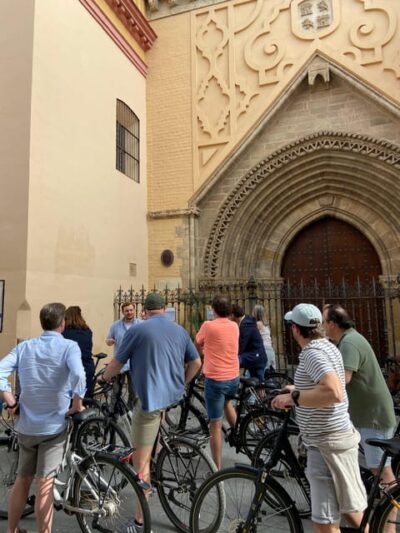
The final historic center section brings you near Seville’s best-known landmarks. The Giralda began as the minaret of the Great Mosque of Seville under the Almohad dynasty. After the Christian conquest, a Renaissance-style top was added, turning the tower into the bell tower of Seville Cathedral.
At 104.1 meters, the Giralda is visible from many parts of the city. Seeing it during a bike ride gives you useful orientation: you can relate the tower to the old quarter, Cathedral, and palace complex instead of viewing it as an isolated monument.
The Cathedral is the fourth-largest church in the world and the largest Gothic church. Its site includes royal burials, chapels, and the tomb of Christopher Columbus and his son Diego. The building occupies about 11,520 square meters, so a brief exterior stop cannot do justice to its interior.
The Royal Alcázar sits nearby. The palace was built for Peter of Castile on the site of an earlier Muslim alcazar and includes Mudéjar, Gothic, Renaissance, and Romanesque elements. The upper rooms are still used by Spain’s royal family when they are in Seville.
These three landmarks, along with the General Archive of the Indies, form a UNESCO World Heritage Site. The bike tour lets you place them in the city’s layout and hear the basic story. It does not replace an entrance visit. You will need separate tickets and time if you want the gardens, palace rooms, Cathedral interior, or Giralda climb.
What the private format changes
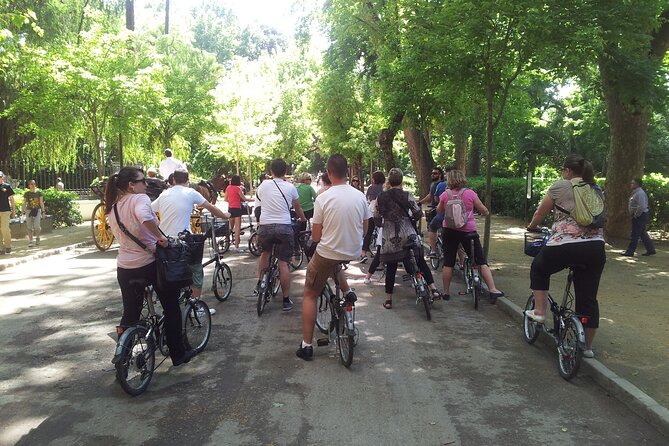
Only your group participates, which is a major advantage for families and small parties. A guide can slow down if someone needs a break, explain a point again, or adjust the focus if you already know the Cathedral and want more time in the park or along the river.
One guide, Elena, was especially appreciated for accommodating breaks. Another rider valued being able to choose among different places to cycle. That flexibility is more useful than it may sound, particularly in a city where each person may have a different priority.
The word private does not mean completely custom-built from the first minute. The main route still centers on María Luisa Park, Plaza de España, the riverfront, Triana, and the central monuments. But within that framework, you have a better chance of shaping the pace than on a large group departure.
The experience also advertises group discounts. Ask for the current price for your party before booking, since the listed rate is $48.06 per person and group pricing may depend on the size of your group.
Is $48.06 a fair price?
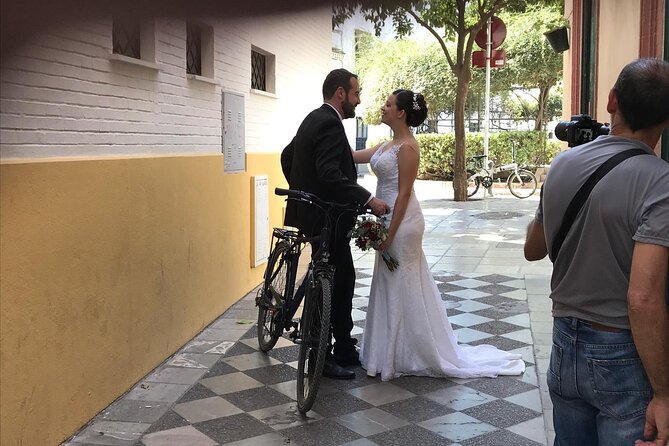
At $48.06 per person, the price is reasonable if you want an overview of Seville with a guide, bicycle, helmet, and bottled water included. You are paying for the equipment, the guide’s time, and the ability to link several parts of the city in one outing.
The value is strongest early in your stay. You can use the tour to mark places for later visits, learn how the river divides the city, and get a first sense of distances. The electric assistance may also save energy for an afternoon of palace or museum visits.
The value is weaker if you already know Seville well, plan to spend the day inside the monuments, or mainly want a relaxed bicycle rental. Some riders found the city so flat and the route so easy that a standard bicycle would have worked just as well.
Food, drinks, and hotel pickup are not included. You need to reach Plaza de Santa Cruz on your own, though the meeting point is near public transportation. The tour ends back there, making it easy to continue exploring the old quarter afterward.
Who should book this ride?
I would recommend it for first-time visitors, families with confident cyclists, couples, and anyone who wants a city overview without a long walking day. It suits mixed fitness levels because the motor can reduce the effort, while stronger riders can simply use less assistance.
It is also a good choice for people who enjoy context. Guides such as Juan, Daniel, Elena, and Ben have been praised for making the ride a small history lesson rather than a silent transfer between photo stops.
I would hesitate to book it for very young children unless the operator confirms bike size first. I would also be cautious if anyone in your group feels uneasy on a bicycle, since the tour operates in all weather and the bikes may be large for shorter riders. Dress for the forecast, and remember that rain has not prevented the ride from going ahead.
The tour is offered in English, but it may be operated by a multilingual guide. Confirmation arrives at booking, and free cancellation is available up to 24 hours before the start time. Changes or cancellations inside that window are not accepted for a refund.
Final verdict: a useful first look at Seville
Book this tour if you want to connect Seville’s major sights in one well-paced outing and prefer a guide’s explanation to a simple rental. The route is varied: garden paths, exhibition architecture, a medieval tower, a historic bridge, a river corridor, and the city’s great palace and church.
Skip it if you want long interior visits or already have a detailed plan for Santa Cruz, the Alcázar, and the Cathedral. In that case, walking and booking monument entries may give you more time where it counts.
For most first visits, I like the balance. You see a large slice of Seville, learn how its Roman, Islamic, Christian, royal, and river stories fit together, and finish with the rest of the day still available.
FAQ
Where does the electric bike tour begin?
The tour begins at Plaza de Santa Cruz, Pl. de Sta Cruz, Casco Antiguo, 41004 Sevilla, Spain.
Where does the tour end?
The activity ends back at the Plaza de Santa Cruz meeting point.
How long does the tour last?
The tour lasts approximately two hours and 30 minutes to three hours.
What is included in the price?
The tour includes a local guide, use of a bicycle and helmet, and bottled water.
Are admission tickets to the monuments included?
No. The route passes the major sights, but food, drinks, and monument admission tickets are not included.
Is the tour suitable for children?
Most people can participate, and a child rate is available when sharing with two paying adults. Bike size can be an issue for shorter children, so confirm suitability before booking.
Just added around Seville
- The Villages of Andalusia: Full-Day Trip from Seville★ 4.8 · 19 reviews
- From Seville: White Villages Tour★ 5.0 · 9 reviews
- White Villages & Ronda 2-Days Trip & Overnight Stay★ 4.6 · 5 reviews
- Your Photo Story in Seville★ 5.0 · 16 reviews
- Triana Market Tapas Tour★ 4.9 · 12 reviews
- Seville: Guided visit of the Casa de Pilatos with entrance tickets★ 4.3 · 18 reviews
- Yoga at María Luisa Park in Seville★ 5.0 · 17 reviews
- From Seville: Wine Tourism Half Day Tour★ 4.0 · 17 reviews
Seville Bike Tours, compared.
Browse the lists this tour appears in