
Reviewed · SEVILLE
The Seville of the 3 Cultures
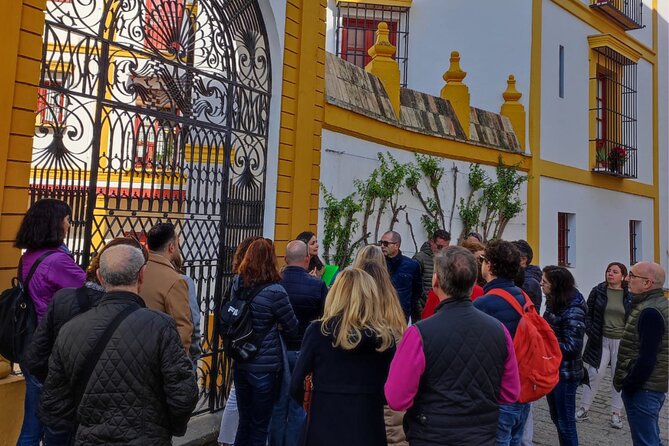
Seville’s past comes into focus on this two-hour walk through the old center. You move from City Hall and the Cathedral to the Jewish Quarter, the Royal Alcázar, the Arenal, and the Torre del Oro, following the city’s Roman, Muslim, Jewish, and Christian chapters. I like the way the route connects famous sights with small lanes and local legends. I also like that it ends near the river, where Seville’s trade and defenses make better sense.
The low price is a major plus at $13.88 per person. The walk also covers a lot of ground without asking you to pay admission at most stops. The tradeoff is pace: with 21 stops in about two hours, you will hear an introduction to many places rather than receive a detailed tour inside each monument.
Key points at a glance
- Four cultural layers: Follow Roman, Muslim, Jewish, and Christian influences through Seville’s oldest districts.
- A long but useful route: Walk from Plaza de San Francisco to the Torre del Oro, passing the Cathedral, Santa Cruz, the Alcázar, Arenal, and the Triana Bridge.
- Story-led sightseeing: Expect legends about Susona, the Giralda, Seville’s Jewish community, kings, pirates, and local superstitions.
- Good value: The $13.88 price includes a two-hour guided walk, with admission free at many outdoor stops.
- Small group limit: The group can reach 20 people, large enough for energy but still manageable in narrow lanes.
- Mobile convenience: Your confirmation arrives at booking, and the tour uses a mobile ticket.
Begin at City Hall and Seville’s old dividing line
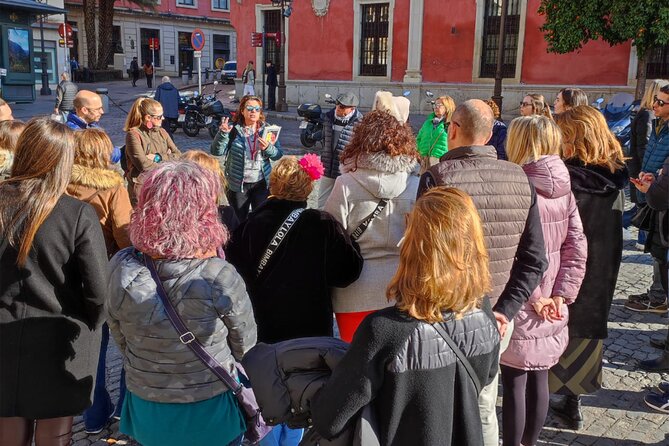
Meet at Plaza de San Francisco, in front of Seville’s City Hall. This is a sensible starting point because the square sits between the old commercial center, including Calle Sierpes, and the grand monumental quarter.
The opening stop gives you a quick orientation to the city. Rather than beginning with a long lecture, the guide uses the City Hall and its surroundings to introduce stories about Seville’s power, commerce, and civic life. You get your bearings before entering the maze of older streets.
This tour is built around short stops. Each one is listed at about five minutes, so expect the guide to point out a detail, tell a story, and move on. That format works well if you want a broad first look at Seville. It is less useful if you want to stand for half an hour at every facade.
The route then moves toward the Puerta del Perdón, the historic gateway beside the Cathedral complex. This is one of the first places where the city’s Muslim and Christian layers meet directly. The guide also tells the story of the Giralda’s collapse, a dramatic reminder that Seville’s most familiar landmark has survived more than appearances suggest.
Other Seville days people weigh up beside this one:
- Seville: Royal Alcázar Entry Ticket
★ 4.6 · 28,378 reviews - Seville: Cathedral and La Giralda Entry Ticket
★ 4.5 · 24,592 reviews - Seville: Live Flamenco Dancing Show Ticket at the Theater
★ 4.7 · 16,396 reviews
The Cathedral, Giralda, and Archbishop’s Palace
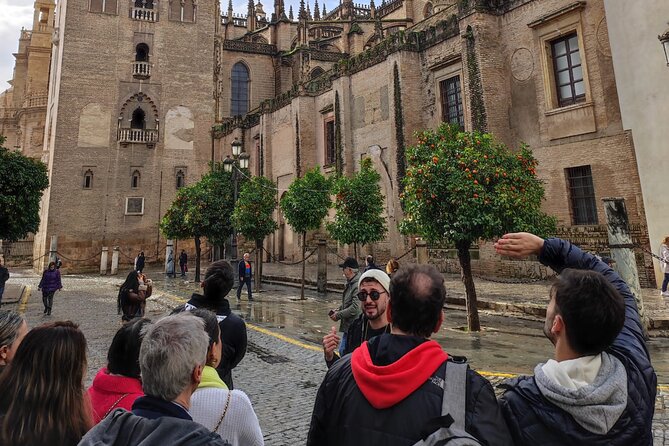
At Plaza de la Virgen de los Reyes, you see the Cathedral beside the Giralda. The stop focuses on details that are easy to miss when you are simply taking photographs: who occupied these spaces, how the buildings were made, and how their use changed over time.
You should not expect entry to the Cathedral or a climb up the Giralda as part of this walk. The itinerary keeps you outside, using the surrounding streets and squares as a stage for explanation. That is important when comparing this tour with a paid monument visit. You receive context, not an interior tour.
The nearby Palacio Arzobispal adds another layer. Its decorated exterior reflects the Church’s authority and taste, while the guide uses it to tell a more human story about an archbishop whose standing in the community changed. The admission note says entry is not included, so plan on viewing this stop from outside.
At this point, you begin to see the main strength of the experience. Seville’s story is not presented as a row of isolated buildings. The guide links religious power, royal authority, trade, and neighborhood life as you walk between them.
Santa Marta and the old Jewish Quarter
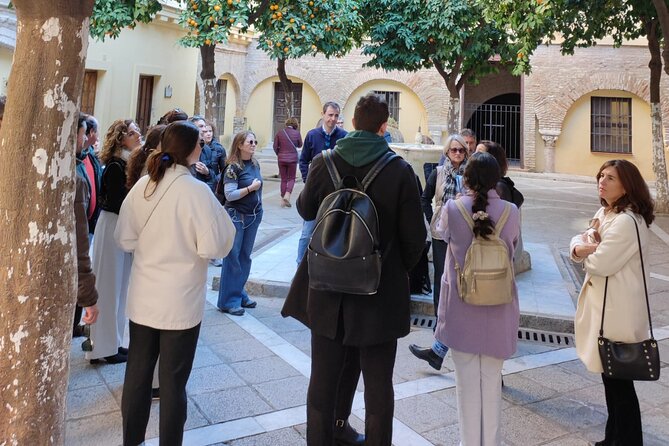
Plaza de Santa Marta is a small, quiet square tucked near the main sights. It gives the tour a welcome change of scale. You leave the large monuments behind and hear about Seville’s Jewish community, one of the city’s most important historic minorities.
This is a good place to pay attention to the physical layout. The Jewish Quarter is not a neat museum district with wide paths and large signs. Its narrow lanes and compact squares require you to look closely. The guide’s role is to help you imagine the people and customs that once shaped daily life here.
From Plaza de la Alianza, the tour explains how different groups passed through and settled in Seville. The city’s identity came from repeated change, not from one single culture. Roman administration, Muslim rule, Jewish life, and Christian power all left marks on the same streets.
The old Jewish Quarter rewards a slower visit, but this walk keeps moving. I would treat these stops as a useful introduction and return later if you want time for quiet photographs or a closer look at the lanes.
Santa Cruz, Susona, and the city’s darker tales
Plaza de Doña Elvira is one of the route’s most attractive photo stops. The guide takes you through the Santa Cruz neighborhood, pointing out corners and streets that are easy to miss if you stay on the main road.
The stop also brings in minority communities and their superstitions. This is where the tour’s style becomes more playful. You are not only hearing dates and political events. You are hearing the stories that people used to explain danger, luck, betrayal, and strange happenings.
Calle Susona carries one of the neighborhood’s best-known legends. The guide presents the events as a story tied to the Jewish Quarter, so expect a dramatic moment rather than a dry architectural explanation. It is a memorable way to connect the lane with the people who lived in this part of Seville.
Calle Vida adds a bit of local wordplay. The route points out that there is also a Calle Muerte, leaving you to decide which way to cross. The surprise is small, but it fits the tour’s interest in names, symbols, and the odd details that make a walking route feel personal.
These stories are a strong reason to choose this experience over a simple sightseeing map. If you want only verified dates and formal architectural facts, parts of the tour may feel light. If you enjoy legends alongside history, Santa Cruz is likely to be one of the most entertaining sections.
A different sort of afternoon in Seville:
- Seville: 1-Hour Guadalquivir River Sightseeing Eco Cruise
★ 4.2 · 10,281 reviews - Seville: Cathedral, Giralda, and Royal Alcázar Guided Tour
★ 4.7 · 9,165 reviews - Seville: Setas de Sevilla Entry Ticket
★ 4.6 · 8,901 reviews - Seville: Cathedral, Giralda & Alcazar Entry With Guided Tour
★ 4.6 · 8,560 reviews
From the Alcázar walls to the Archive of the Indies
The walk continues through the Judería and toward the Patio de Banderas. Here you reach the edge of the Royal Alcázars, one of Seville’s key royal sites. The guide explains who succeeded whom inside these walls and what different rulers left behind.
Again, this is an exterior visit. You see the setting and hear its story, but admission to the Royal Alcázar is not part of the $13.88 walk. If the palace is high on your list, reserve a separate entrance for another time. This tour can help you understand what you are looking at before you go inside.
At the Puerta del León, the focus shifts to symbols, defenses, heraldry, customs, and the kings connected with the complex. The gate works well as a storytelling point because it presents the Alcázar as both a residence and a fortified seat of power.
The Archivo General de Indias continues the royal and commercial story. The guide explains why the archive is associated with pirates, then turns to what has been carefully preserved there. You will view the exterior, and admission is not included.
This part of the walk is especially useful for people who want to understand Seville’s place in overseas trade. It also helps explain why the city accumulated so many grand buildings and competing claims to power. You get the setting without paying a second attraction fee during the tour.
Baroque Seville and the Giraldillo
At the Monumento a la Inmaculada Concepción, the route moves into Seville’s later Christian and artistic identity. The guide brings in painters, the Baroque period, and the idea that Seville was home to what is described as the first marketing campaign in history.
That claim is presented as part of the tour’s collection of unusual details, so listen for the explanation rather than treating the phrase as a complete history lesson. This is typical of the experience: a familiar square becomes a prompt for a surprising fact.
The Giraldillo is one of the walk’s most recognizable sights. The guide points out the city icon and warns that your eyes can misjudge its scale and position. You get a useful photo stop, but not the time or access for a full visit to the Cathedral tower.
This stretch works well for photographs. It also gives you a chance to connect Seville’s Christian monuments with the earlier Muslim structure beneath and around them. The city’s changes are visible in the buildings, even when the tour presents them in quick pieces.
Torre Abdel Aziz and the Arenal Quarter
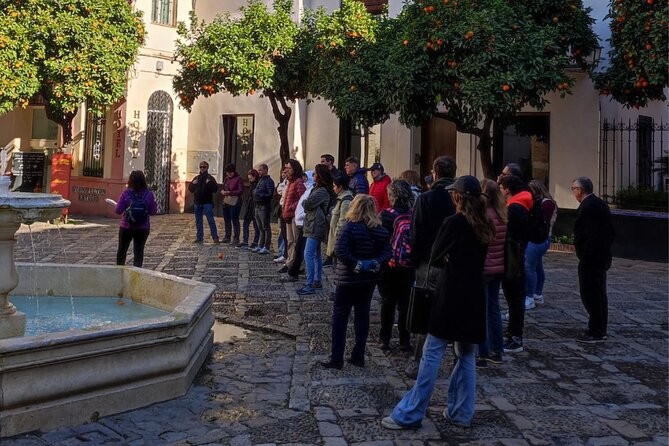
At Torre Abdel Aziz, the guide uses a photo-friendly viewpoint to show the scale of Seville’s towers, walls, palaces, and large houses. This is a welcome pause after the tight lanes of Santa Cruz. You begin to see how the old city was defended and how its major buildings were arranged.
The walk then reaches the Arco del Postigo del Aceite. Its name and setting open the door to stories about Seville’s trade, hard times, and better days. The Arenal district has a more open connection to the river, and its past is tied to movement, goods, defense, and public life.
The route next enters Plaza del Cabildo. This curved square and its passageways are easy to miss if you are hurrying between the Cathedral and the river. The guide shows you where to look and explains how the space was used. I would mark this as one of the stops worth revisiting after the tour, since its details are easier to appreciate when you are not keeping up with a group.
At Mercado Artesanía El Postigo, the focus returns to the many communities that settled in Seville. The market adds a present-day touch to the route, though the tour’s main interest remains the history and character of the area.
Crossing to the river and finishing at the Torre del Oro
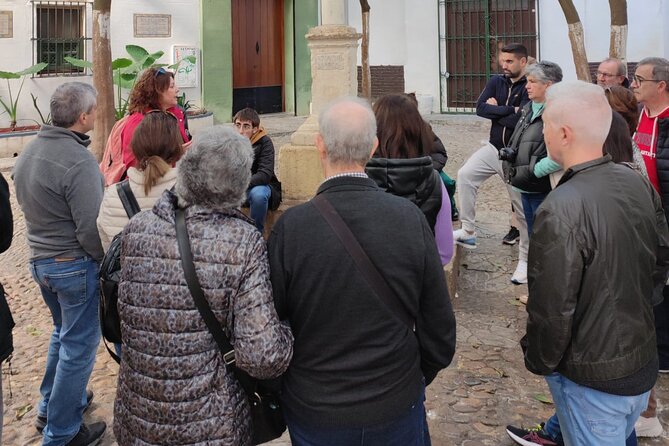
The walk continues toward the Puente de Isabel II, better known as the Triana Bridge. This is a natural place for photographs and comparisons. The guide also brings in stories about pilgrims and other figures who crossed the river.
The bridge links the old center with Triana, although this particular route ends on the central Seville side near the Torre del Oro. It gives you a sense of how the river shaped movement through the city. By this point, the earlier stories about trade, defense, and cultural exchange have a clear physical setting.
The final stop is the Torre del Oro on the Paseo de Cristóbal Colón. The tower brings the experience back to Seville’s riverfront defenses and commercial power. It is a fitting endpoint because the route has moved from civic buildings and religious monuments to the waterway that helped make Seville important.
Admission to the Torre del Oro is not included. You can still see the tower from outside and finish with photographs near the river. The guide saves the final explanation for this location, so the walk closes by tying together the city you have just crossed.
What the $13.88 price really gives you
At $13.88 per person, this is an inexpensive way to get structure and context during your first hours in Seville. The value comes from the guide’s stories and route design, not from included monument tickets.
You pass 21 listed locations in about two hours. That works out to a quick rhythm, with many stops lasting only a few minutes. You cover a great deal, but you should not expect a slow architectural study or long time for photographs at every site.
The group limit is 20 people. That is not a private walk, but it is smaller than a large coach group and better suited to narrow streets. A mobile ticket keeps arrival simple, and confirmation is sent when you book.
The tour is booked an average of 27 days ahead, so it is sensible to reserve early if your dates are fixed. You can cancel for a full refund up to 24 hours before the start time. Within 24 hours, the payment is not refunded.
Who will enjoy this Seville walk
I would choose this for a first visit, especially if you want to see how the city’s cultural layers fit together before choosing which monuments deserve a longer visit. It is also useful for people who like local legends, unusual facts, and neighborhood stories more than a formal lecture.
The route suits most people, and service animals are allowed. It is near public transportation, though the supplied details do not specify a particular bus, tram, or metro stop. Wear comfortable shoes, since the experience is a continuous city walk through old streets and squares.
You should look elsewhere if your main goal is interior access to the Cathedral, Alcázar, Archive of the Indies, or Torre del Oro. None of those admissions is included. You should also allow extra time if you want to explore the Jewish Quarter or Santa Cruz at a relaxed pace after the guide has shown you the key corners.
The guide can make a large difference. Alfredo has led a Seville walk that places the Triana area in context and brings in curious details. Jose has guided a Santa Cruz route with stories and a lively way of presenting the neighborhood. Guide assignments can vary, so book this for the route and format rather than a guaranteed individual guide.
Should you book The Seville of the 3 Cultures?
Book it if you want a fast, story-filled orientation to Seville for very little money. The route covers the city’s main historic zones, adds legends such as Susona, and finishes at the Torre del Oro with a clear sense of how the river shaped the city.
Skip it if you prefer long visits inside monuments or a slow photography walk. With 21 stops in two hours, the experience gives you many useful starting points but leaves the detailed exploration for you afterward. For most first-time visitors, that is a fair trade at $13.88, especially when you use the walk to plan the rest of your Seville stay.
FAQ
How long does The Seville of the 3 Cultures last?
The walk lasts approximately two hours.
Where does the tour begin?
It begins at Plaza de San Francisco, 17, in Seville’s Casco Antiguo, near City Hall.
Where does the tour finish?
It finishes near the Torre del Oro on Paseo de Cristóbal Colón, about two hours after the start.
How much does the experience cost?
The listed price is $13.88 per person.
How many people can join the group?
The experience allows a maximum of 20 people.
Is the tour available with a mobile ticket?
Yes. A mobile ticket is provided, and confirmation is received at the time of booking.
Are monument admission fees included?
Admission is not included at the Palacio Arzobispal, Puerta del León, Archivo General de Indias, or Torre del Oro. Many of the outdoor stops have no admission charge.
Can I cancel for a full refund?
Yes. You can cancel at least 24 hours before the experience starts for a full refund. Cancellations or changes made within 24 hours are not refunded or accepted.
Is the tour suitable for most people?
Most people can participate. Service animals are allowed, and the route is near public transportation.
Just added around Seville
- The Villages of Andalusia: Full-Day Trip from Seville★ 4.8 · 19 reviews
- From Seville: White Villages Tour★ 5.0 · 9 reviews
- White Villages & Ronda 2-Days Trip & Overnight Stay★ 4.6 · 5 reviews
- Your Photo Story in Seville★ 5.0 · 16 reviews
- Triana Market Tapas Tour★ 4.9 · 12 reviews
- Seville: Guided visit of the Casa de Pilatos with entrance tickets★ 4.3 · 18 reviews
- From Seville: Wine Tourism Half Day Tour★ 4.0 · 17 reviews
- Wine tourism, visit to a traditional winery and wine tasting★ 5.0 · 3 reviews