
Reviewed · WALKING TOURS
Walking tour through the monumental and historical area of Seville
Seville’s grand center fits together beautifully on foot, and this tour connects its biggest sights with the stories between them. You move from a former mosque courtyard to the cathedral, Jewish quarter, tobacco factory, Plaza de España, and the Guadalquivir River, all with a local guide at your side.
I like the private format, since your guide can adjust the pace and answer your questions. I also like the practical side: Francisco, Miguel, Luis, and Marcio have been praised for city tips, restaurant suggestions, map help, and personal stories. The main thing to consider is the long, brisk walk. The tour is advertised at about two hours, but the route and past experiences suggest you may spend closer to three hours on foot.
Key points to know before booking
- A full historic sweep: Cover Seville’s cathedral area, Alcázar, Santa Cruz, Plaza de España, María Luisa Park, and Torre del Oro in one outing.
- Private attention: Only your group participates, so the guide can tailor the walk to your interests.
- Guides with personality: Francisco, Miguel, Luis, and Marcio have all led tours, with an emphasis on stories, questions, and local suggestions.
- Mostly an exterior tour: The listed stops include free admission, but this experience does not present itself as an interior visit to the cathedral or Alcázar.
- Sturdy footwear matters: Expect pavement, cobblestones, dirt paths, optional stairs, and a steady pace.
- Flexible planning help: You can use the tour to get your bearings, mark places for later, and ask about food, drinks, restrooms, and other sights.
A smart first morning in Seville
The walk begins at Sevilla Moving on Calle Luis Montoto at 10:00 a.m. That start point is near public transportation, and the activity returns there at the end. You receive a mobile ticket, and the tour is offered in English.
This is best used near the beginning of your stay. You will see the city’s main historic zones in a logical order, then have a map in your head for the rest of your visit. A guide can also point out places to revisit on your own, which gives the tour more value than a simple checklist of monuments.
The route covers a lot. The published duration is approximately two hours, but the scheduled stop times add up to longer, and one account describes a three-hour outing. Plan your morning accordingly. The walking itself is not extreme for an active visitor, but the pace is steady and the surfaces change often.
More Historical Tours in Seville:
- Sevilla Food Tour: Tapas, Wine, History & Traditions
★ 5.0 · 3,468 reviews - Ultimate Seville Tapas, Wine & History Small Group Tour
★ 5.0 · 1,766 reviews - Seville: Tapas, Taverns, and History Walking Tour
★ 4.9 · 676 reviews
From the Divino Salvador to Seville’s civic center
The first stop is the Church of the Divine Savior, or Iglesia del Divino Salvador. Here, the guide explains the city’s origins and takes you into the courtyard of the old mosque. That opening gives you an early look at Seville’s layers: Islamic buildings, Christian worship, and later urban changes sharing the same ground.
The stop is brief, around ten minutes, so do not expect a full church tour. Its value is as a starting lesson. Your guide can explain what you are looking at before the walk reaches Seville’s more famous monuments.
Next comes Plaza de San Francisco, a civic square linked with the City of Seville. The tour uses about ten minutes here to discuss one of the city’s examples of Spanish Plateresque art. This is a quick architectural pause, not a long museum-style lecture.
I like this early section because it builds context before the big postcard sights. You begin by looking at fragments and public buildings, rather than rushing straight to the cathedral tower.
Cathedral doors, orange trees, and La Giralda
The cathedral area receives about twenty minutes. You will see the Door of Forgiveness, described as the oldest door of the cathedral, and the Patio de los Naranjos, or Orange Tree Courtyard. The courtyard preserves elements from the former mosque, making it one of the clearest places to see how the religious center changed over time.
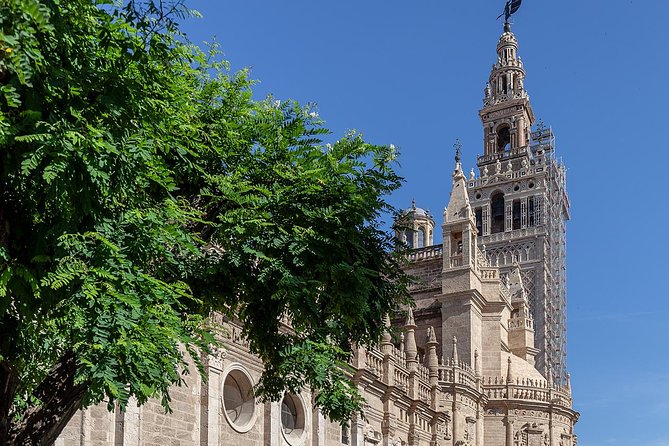
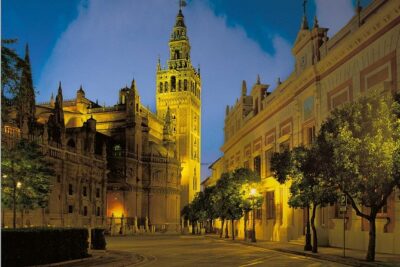
The guide also covers the outside of the cathedral, the Royal Chapel exterior, and La Giralda. Seville’s famous tower began as a minaret, and its later Christian use is central to the city’s visual identity. From the outside, your guide can help you read the building as a record of changing rulers and faiths.
A key limitation is worth stating plainly: the stop is listed with free admission, and the experience does not include an interior entrance to the cathedral. If you want to see the main altarpiece, tomb of Christopher Columbus, or the inside of La Giralda, you will need separate admission and time.
Still, this is a useful orientation stop. You learn where the major entrances are, how the cathedral connects to the old mosque, and what deserves a return visit.
The Alcázar facade and Archivo de Indias
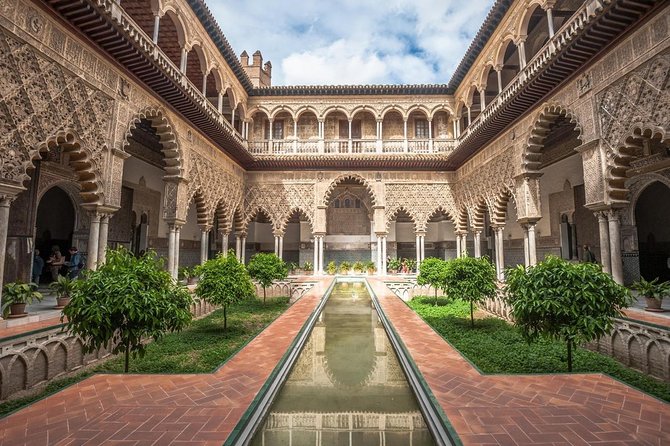
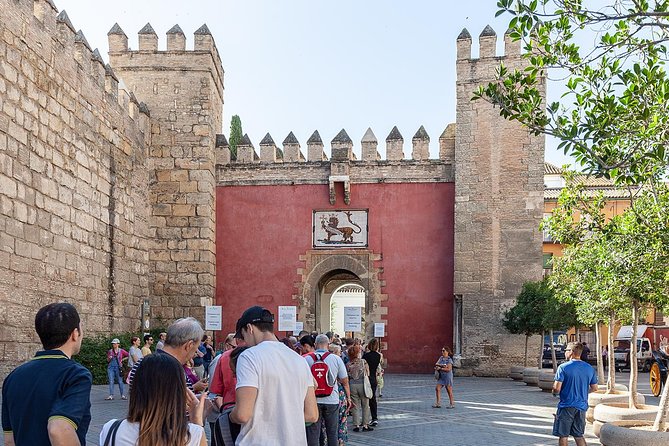
The route continues to the Royal Alcázar, focusing on its facade and the Patio de Banderas. This broad approach gives you a sense of the palace complex without turning the walking tour into a full palace visit.
The Alcázar is one of Seville’s major sights, so many people will want to go inside later. The walk helps you understand its position beside the cathedral and old Jewish quarter. It also lets you ask your guide how to fit a separate visit into your plans.
The Archivo General de Indias gets about five minutes. That may sound short, but the guide uses the stop to introduce one of Spain’s most important historical archives. Its documents preserve the relationship between Spain and the American colonies.
Again, this is an exterior and context stop rather than an archive visit. The value comes from connecting Seville’s streets with the wider story of Spanish exploration, administration, and empire.
More Walking Tours in Seville:
- Seville: Small-Group City Highlights Walking Tour
★ 5.0 · 1,204 reviews - Cultural Walking Tour of Seville Monumental
★ 5.0 · 861 reviews - Seville: Tapas, Taverns and History Guided Walking Tour
★ 4.9 · 515 reviews - Seville: Small-Group Jewish Quarter Discovery Walking Tour
★ 4.9 · 499 reviews
Santa Cruz, the old Jewish quarter
From the monumental center, you walk into Barrio Santa Cruz. This was Seville’s Jewish district, and the narrow streets give the tour a different feel from the formal squares around the cathedral.
The walk through Santa Cruz lasts about fifteen minutes on the published plan. Expect turns, uneven paving, and close streets. This is where a local guide can add the most texture, since the interest is not tied to one single ticketed monument.
The tour then heads toward the Murillo Gardens. Along the way, you may get suggestions for places to return to, eat, or explore. Miguel, one of the guides associated with this experience, has been especially praised for adding local stories and pointing out less obvious corners of the city.
This part also shows why a private walk can work well. You can stop for photographs, ask about the neighborhood, or shift the focus toward architecture, local life, or history without waiting for a large group.
Murillo Gardens and the old tobacco factory
The Jardines de Murillo occupy former orchards belonging to the Alcázar. Today they are public gardens with magnolias, orange trees, ficus, night-blooming plants, gazebos, fountains, ceramics, and monuments.
The scheduled visit lasts around fifteen minutes. It is a pleasant change after the hard surfaces of the old center, though the stop is still brief. If you enjoy gardens, you may want to return later with more time.
The next major point is the former Royal Tobacco Factory, now the University of Seville. It was once Europe’s most important tobacco factory and is now an important industrial and cultural building.
The route crosses its large corridors and courtyards on the way to Plaza de España. That passage gives you a sense of the building’s scale. It is not just another handsome facade. Its former purpose explains why the complex feels so broad and institutional.
The published timing allows about fifteen minutes here. Since this is an active university site, the walk should be treated as a passage and explanation, not a guaranteed full interior tour of every area.
Plaza de España deserves the longest stop
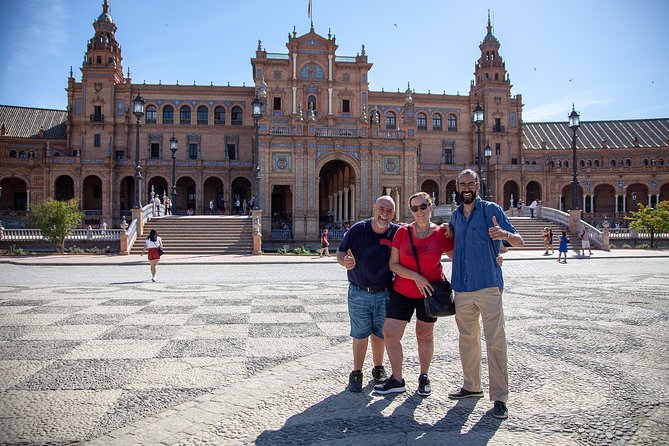
Plaza de España receives about thirty minutes, the longest stop on the route. That is sensible. The square was built for the 1929 Ibero-American Exposition, which brought together American countries and gave each a presence through pavilions and official buildings.
This is the place where the tour’s many historical threads come together. The architecture presents Seville as a city looking outward, with grand civic design shaped by Spain’s links to the Americas.
You will have time for photographs and a proper look at the tiled details, bridges, water, and curved form of the plaza. A guide can also explain why the square was built and how it fits into Seville’s modern history.
The drawback is timing. Thirty minutes is enough for an introduction, but not for a slow, detailed study of every tile and corner. If Plaza de España is high on your list, plan to return later, especially when you can explore without keeping up with the group.
María Luisa Park and the walk to the river
After Plaza de España, the route enters María Luisa Park, Seville’s first urban park and one of its main green spaces. It opened as an urban park in 1914 and was declared a Historic Garden of Cultural Interest in 1983.
The scheduled visit lasts about twenty minutes. You will see a park shaped by paths, trees, planted areas, and historic design. The setting offers a calmer counterpoint to the cathedral district and makes the route feel less like a march between monuments.
Because the tour covers the park on foot, comfortable shoes are especially useful here. The walk can include dirt as well as pavement, and the changing ground is one reason not to wear thin sandals or slick soles.
The final listed sight is Torre del Oro, a riverside albarrana tower on the Guadalquivir. It once helped watch over Seville’s old port and was declared a historic-artistic monument in 1931.
The stop is planned for about ten minutes. It is a fitting ending to a tour that has moved through religion, royal power, trade, industry, public gardens, and the river that helped connect Seville to the wider world.
What the guides add
The guide is the main reason to book this experience instead of following the same route with a map. The tour has been led by Francisco, Miguel, Luis, and Marcio, depending on availability.
Francisco has been praised for giving a friendly introduction, answering questions, and marking favorite places on a map. Miguel is associated with humor, strong local pride, food and drink suggestions, and stories about less obvious parts of the city. Luis has handled question-heavy tours well, including conversations that move from Spanish history to books, films, and notable people. Marcio has been described as professional, pleasant, and generous with anecdotes.
You cannot request a particular guide with certainty from the information provided, so treat those names as examples rather than a promise. What you can expect is a personal format. Since only your group participates, the guide can adjust the conversation and customize the route within the planned sights.
The tour also includes practical help. One guide made a point of identifying restroom opportunities, which matters in Seville because public facilities can be hard to find. A small snack share and a stop at an upscale candy shop were also part of one outing, but these should be viewed as possible personal touches, not fixed inclusions.
Price, pace, and who gets the best value
At $49.37 per person, the tour is not the cheapest way to walk around Seville. Its value depends on how much you want a guide’s explanation and local advice.
The price is easier to justify for a first visit, especially if you want a quick mental map of the historic center. You are not paying for cathedral, Alcázar, or archive admission, so budget separately for those interiors. You are paying for a private guide, a planned route, historical context, and the chance to ask questions.
I would recommend it most strongly to first-time visitors, couples, families, and small groups who want flexibility. It also suits anyone who prefers history explained in plain language instead of reading several guidebooks before arriving.
You should think twice if you dislike brisk walking, want long photo stops, or mainly want to enter the cathedral and Alcázar. This is a broad introductory circuit, not a detailed interior tour of Seville’s two biggest monuments.
Wear sturdy shoes. Expect pavement, cobblestones, dirt, and some stairs, though most stairs are optional. Service animals are allowed, and most people can participate, but the physical length and uneven ground still matter.
The experience requires good weather and a minimum number of participants. If weather or minimum numbers cancel the tour, you are offered another date or experience, or a full refund. You can cancel for a full refund up to 24 hours before the 10:00 a.m. start.
Should you book this Seville walk?
Book it if you want one well-planned morning that links Seville’s major historic zones and gives you useful ideas for the rest of your stay. The private setup, local recommendations, and guide-led storytelling are the strongest reasons to choose it.
Skip it if you already know Seville well or want extended time inside the cathedral and Alcázar. For everyone else, this is a practical first-day introduction, provided you arrive ready to walk and accept that the real duration may run longer than the advertised two hours.
FAQ
Where does the tour start?
It starts at Sevilla Moving, C. Luis Montoto, 19, Local Bajo, 41003 Seville, Spain.
What time does the tour begin?
The scheduled start time is 10:00 a.m.
Where does the tour end?
The activity ends back at the meeting point.
How long does the tour last?
The advertised duration is approximately two hours. The route and past experience indicate that it may take closer to three hours, depending on pace and stops.
Is the tour private?
Yes. Only your group participates in the activity.
Is the tour offered in English?
Yes. English is the listed language.
Does the price include admission to the cathedral or Alcázar?
The listed stops show free admission, and the experience focuses on exteriors and public areas. Separate admission is not listed for entering the cathedral or Alcázar interiors.
Is the tour suitable for people with limited mobility?
Most people can participate, but the route includes pavement, dirt, cobblestones, and some stairs. Most stairs are optional, and service animals are allowed.
Can I cancel for a full refund?
Yes. You must cancel at least 24 hours before the local start time for a full refund. If poor weather or insufficient numbers cancel the activity, you are offered another date or experience, or a full refund.
Just added around Seville
- The Villages of Andalusia: Full-Day Trip from Seville★ 4.8 · 19 reviews
- From Seville: White Villages Tour★ 5.0 · 9 reviews
- White Villages & Ronda 2-Days Trip & Overnight Stay★ 4.6 · 5 reviews
- Your Photo Story in Seville★ 5.0 · 16 reviews
- Triana Market Tapas Tour★ 4.9 · 12 reviews
- Seville: Guided visit of the Casa de Pilatos with entrance tickets★ 4.3 · 18 reviews
- Yoga at María Luisa Park in Seville★ 5.0 · 17 reviews
- From Seville: Wine Tourism Half Day Tour★ 4.0 · 17 reviews
Walking Tours, compared.

Small-Group Jewish Quarter Discovery Walking Tour
Read our review →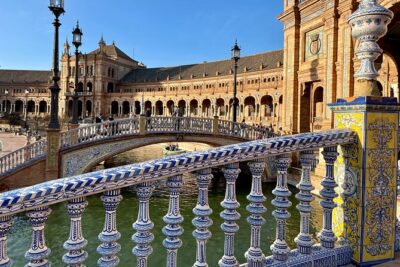
Seville Private Walking Tour with Alcazar & Cathedral Tickets
Read our review →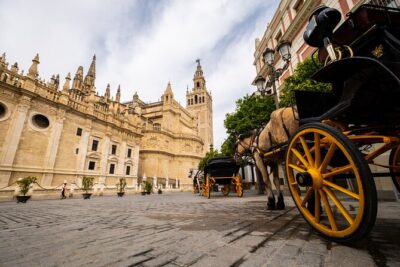
Seville Small-Group Monumental Highlights Walking Tour
Read our review →
Browse the lists this tour appears in