
Reviewed · ITALICA ROMAN CITY TOURS
Italica Roman City Tour from Seville
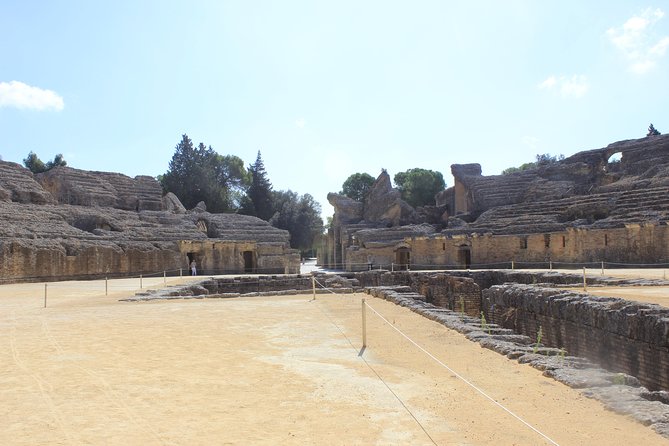
Italica is where Seville’s Roman past becomes wonderfully physical. You walk ancient streets, step around mosaic floors, and stand inside an amphitheater built for about 25,000 spectators, all only 15 minutes from the city. The site was founded in 206 B.C. and later produced emperors Trajan and Hadrian.
I like the easy half-day format and the chance to see details you could miss alone, especially the Traianeum, public baths, and house mosaics. Guides such as Jesus, Luca, Catherine, and Alberto have been praised for bringing the ruins to life with stories and humor. The main caution is that guide quality and language handling can vary, and some departures include an unexpected monastery stop that reduces Italica time.
Key points to know before you go
- A quick escape from Seville: Italica is roughly 15 minutes away by vehicle, making this a useful morning trip.
- The amphitheater is the star: Its huge bowl once held around 25,000 people and ranks among the Roman Empire’s largest.
- The mosaics reward close attention: The ruins include decorated floors, statues, baths, streets, and public buildings.
- The guide shapes the experience: Jesus, Luca, Catherine, and Alberto have all been praised, but English fluency and presentation can vary.
- Expect real walking: Uneven ground, changes in level, heat, and limited shade make sturdy shoes and water sensible.
- The schedule may change: Some departures have included Santiponce’s San Isidoro del Campo monastery, so check the current details before booking.
Why Italica is worth leaving Seville
Seville is filled with Roman traces, but Italica lets you see a Roman city laid out at a much larger scale. The settlement began in 206 B.C., after Roman General Publius Cornelius Scipio Africanus founded it. It later became associated with two emperors, Trajan and Hadrian, giving the site unusual importance in Roman Spain.
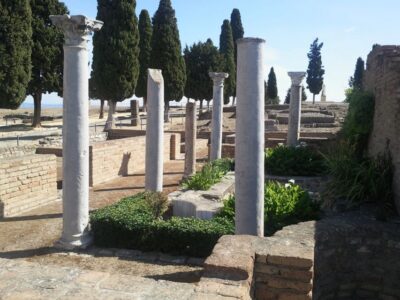
The appeal is not just the age of the ruins. Italica lets you picture daily life. You follow broad old streets, pass the remains of homes and public buildings, and look down at mosaic floors that still carry their original patterns. The public baths show how much Roman life depended on shared civic spaces, not just private homes and temples.
I especially like that this is an archaeological visit with enough surviving detail to reward a guide. A pile of stone can be hard to read on your own. A good explanation helps you understand where people walked, gathered, worshipped, bathed, and watched spectacles.
The site also has a pop-culture connection. Parts of the amphitheater were used as a filming location for Game of Thrones, and some guides point this out. That is a fun extra, but the Roman story is the real reason to come.
More Italica Roman City Tours:
- From Seville: Italica Roman City & Medieval Monastery Tour
★ 4.5 · 1,051 reviews - Historical Italica: Half-Day Guided Tour from Seville
★ 4.5 · 416 reviews - Seville: Game of Thrones and Roman Empire Italica Tour
★ 4.3 · 372 reviews
The 10:00 a.m. trip from Seville
The tour starts at 10:00 a.m. and uses an air-conditioned vehicle. Italica is close to Seville, with the drive described as roughly 15 to 20 minutes, so you do not lose half your day to transport.
That short ride is one of the tour’s strongest practical points. You can visit a major Roman site without arranging a rental car or working out local transport. The vehicle also matters on hot Andalusian days, when a cool ride is far more welcome than a long wait outside.
The total experience is advertised at about four hours. That includes transport and the site visit, not four full hours inside Italica. A realistic plan should allow around two hours at the Roman ruins on departures that also include a monastery stop, plus time for driving and additional visits.
Some departures have involved three language groups, with English, Spanish, and French commentary handled together. The operator notes that the order of visits can change, and the tour may be conducted in two languages to manage those changes. That can work well with a strong guide, but it can also make the explanations feel slower or less focused.
The maximum group size is 55 people. That is a fairly large group for an archaeological site. It keeps the price reasonable, but it means you should stay close to the guide, especially when standing among large ruins or walking on uneven ground.
Walking through the ancient city
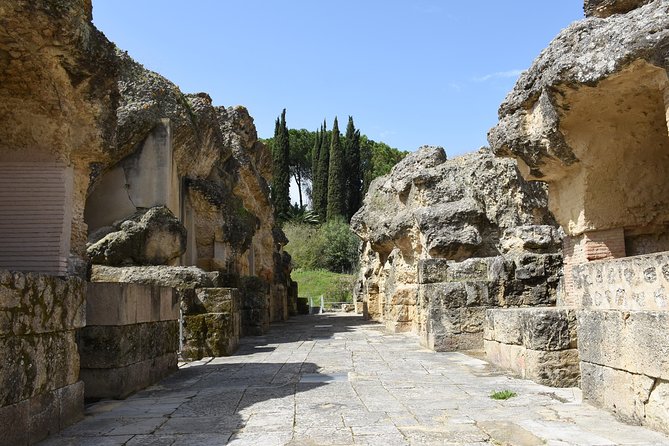
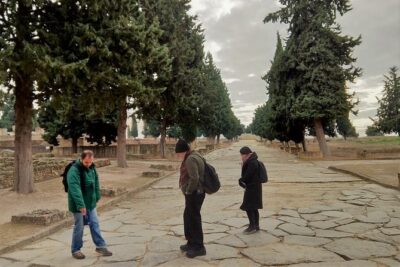
The main archaeological ensemble is open and spread out. You will walk along old streets and move between the remains of houses, public buildings, baths, and monumental spaces. This is not a quick bus stop with a single famous ruin. The site asks you to keep moving and pay attention to the shape of the city.
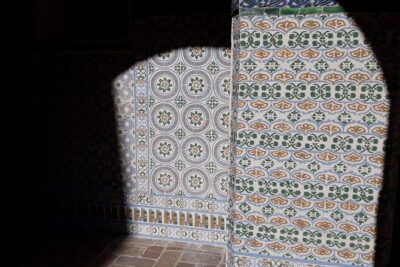
The houses are important because they make Italica feel lived in. Mosaic floors hint at decoration and status, while the street plan gives you a sense of how Roman neighborhoods were organized. The guide’s job is to turn those fragments into a picture of homes, civic life, and social order.
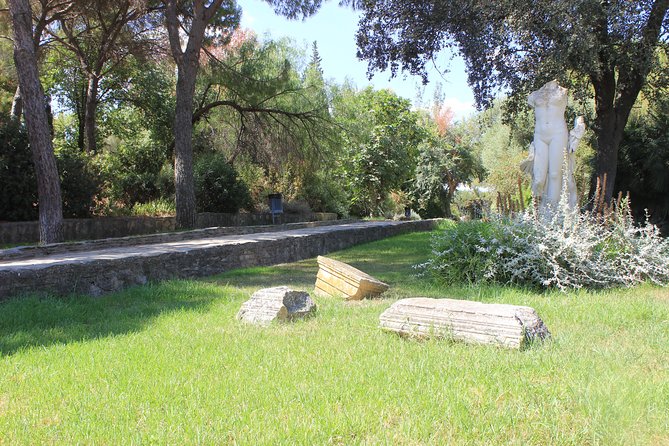
The Traianeum is another major stop. This monumental complex was linked to the emperor Trajan and gives the visit a stronger sense of ceremony and power. Statues associated with Diana, Venus, and Trajan add human figures to what might otherwise feel like an abstract field of walls and paving.
The public baths help explain the social side of Roman culture. They were not simply places to wash. They were public buildings where people spent time, met others, and took part in a civic routine. You will appreciate this stop more if your guide explains how the different areas worked rather than simply pointing out the surviving foundations.
The site is also photogenic. The combination of open sky, long ancient streets, mosaic floors, and the amphitheater makes it easy to take memorable pictures. Still, the guided pace may leave you wanting another 20 or 30 minutes to wander and photograph details after the explanations finish.
Entering the 25,000-seat amphitheater
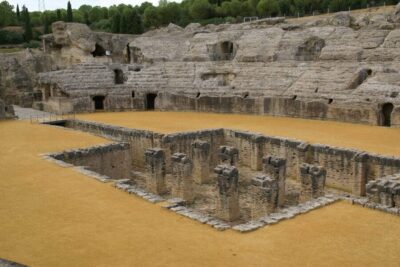
The amphitheater is the clear centerpiece. Its estimated seating capacity was about 25,000, and it was the third-largest in the Roman Empire. That scale is hard to grasp from a photograph. Once you stand inside the bowl, the size becomes the story.
Look at how the seating area is arranged around the central arena. The structure was designed to move a large crowd through a controlled space and keep the action visible. Even in its ruined state, the amphitheater gives you a strong sense of Roman engineering and public entertainment.
This is also the place where the Game of Thrones connection is most useful. A guide can show you the filming area and then bring the focus back to what the building meant in Roman times. The modern screen connection may draw you in, but the ancient architecture gives the stop its lasting interest.
Because the amphitheater is open and exposed, heat can be a serious factor. Several departures have taken place in strong sunshine, and the walking can feel demanding. Bring water, wear a hat, and use sturdy shoes with a good grip. Sandals with thin soles are not ideal on rough surfaces and level changes.
More City Tours in Seville:
- Seville: City Sightseeing Hop-On Hop-Off Bus Tour
★ 4.0 · 4,633 reviews - City Sightseeing Seville Hop-On Hop-Off Bus Tour
★ 4.0 · 1,782 reviews - Seville: Small-Group City Highlights Walking Tour
★ 5.0 · 1,204 reviews - Seville: City Sightseeing and Local Culture Bike Tour
★ 4.9 · 1,120 reviews
The Roman theater and Santiponce
The itinerary also refers to a partially reconstructed Roman theater in Santiponce, the town beside Italica. This gives you another way to understand Roman public life. The amphitheater was built for mass spectacles, while a theater served performance and civic culture on a different scale.
The theater may not receive as much time as the main archaeological ensemble, depending on the group schedule and the order of visits. If you care strongly about seeing it, ask the guide how it fits into that day’s plan.
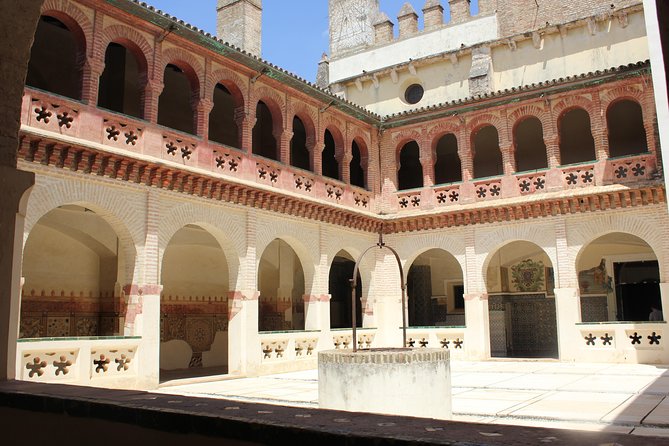
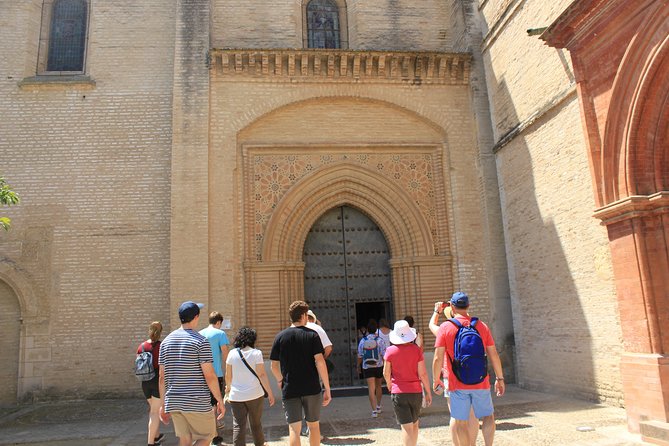
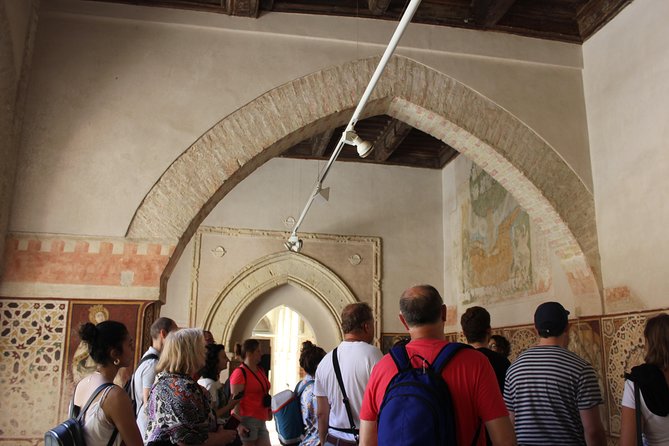
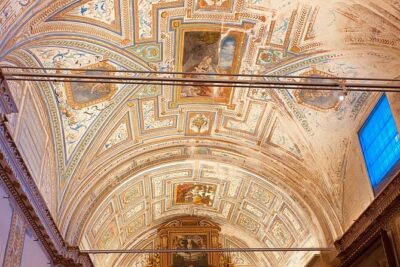
Some departures also include a short stop at the nearby Monastery of San Isidoro del Campo. This stop is not consistently clear in the basic description, and it has surprised people who chose a tour focused only on Italica. It can add another layer of local history and art, but it also reduces the time available for the Roman site.
The monastery has been described as partly under restoration, with some areas available to see and others closed or incomplete. A stop of around 30 minutes gives you an introduction rather than a full visit. I would treat it as a bonus only if you are happy with a broader outing. If you want every minute devoted to Italica, confirm the day’s plan before paying.
How much the guide matters
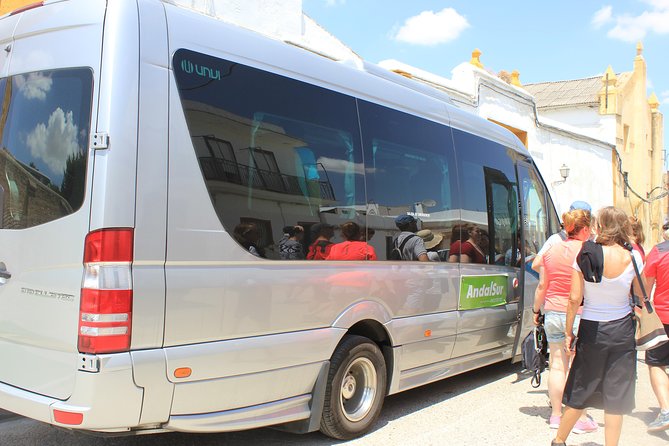
A good guide changes this visit. Luca has been praised for explaining Roman history and Andalusian history clearly, using stories to help you picture how buildings worked. Jesus has also been singled out for his enthusiasm, humor, and strong grasp of the site. Catherine and Alberto have received praise for their energy, clarity, and warmth.
Those names are useful examples, but you cannot count on a particular guide being assigned. The experience is offered in English, yet English fluency has not been consistent on every departure. Some guides have used awkward translations, false cognates, or accents that were difficult for some people to follow.
There have also been complaints about guides speaking while walking too far ahead, or spending too much time in Spanish when several language groups were combined. That is a real concern at a site where much of the value comes from interpretation rather than simply seeing stones.
The best approach is to stay close, ask for clarification when needed, and make sure you can hear before the group moves on. If the guide is strong, the tour can turn a confusing ruin into a readable city. If the commentary is weak, you may feel that the visit gives you less than a self-guided visit with a good guidebook.
Price, group size, and overall value
At $46.85 per person, this is priced as an accessible half-day excursion rather than a private archaeological tour. The price includes admission, an art historian guide, an air-conditioned vehicle, and priority access intended to avoid long lines.
That is good value if you want transport and interpretation without renting a car. Italica is close, but arranging the trip yourself still requires transport planning, entry arrangements, and a way to make sense of a large site. The tour handles those basics in one package.
The trade-off is the group size, which can reach 55 people. You are paying for convenience, not an intimate seminar. A private visit would make it easier to ask questions, stop for photos, and move at your own pace, but it would cost more.
The tour is also best understood as a four-hour outing, not a four-hour archaeological study. If a monastery stop is added, the Roman ruins may receive about two hours. That is enough for the amphitheater, main streets, mosaics, Traianeum, baths, and a general explanation, but not enough for slow photography or every corner of the site.
Who should book this Italica tour?
I would choose this tour if you have limited time in Seville, want an English-speaking guide, and prefer a simple vehicle transfer. It suits people who enjoy ancient sites but do not want to spend an entire day organizing the visit.
It is also a good choice for first-time visitors to Italica. The city is easier to appreciate when someone explains what the buildings were used for and points out details you might walk past.
Families and Game of Thrones fans may enjoy the amphitheater connection, though the rough walking and hot sun can be tiring for young children. Anyone with only a low level of physical fitness should think carefully, since the tour requires walking over uneven ground with changes in level.
I would hesitate if you want a quiet, highly focused archaeological experience. A group of up to 55 people, multiple languages, changing visit orders, and a possible monastery stop can make the day feel less precise than the description suggests.
Free cancellation is available up to 24 hours before the start time for a full refund. Changes or cancellations inside that window are not accepted for a refund, and poor weather can lead to a new date or full refund.
Should you book it?
Book it if you want an easy, reasonably priced introduction to Italica and value having a guide explain the mosaics, baths, Traianeum, theater, and amphitheater. The short ride from Seville makes this one of the simplest ways to add Roman Spain to your itinerary.
Before booking, confirm if your departure includes San Isidoro del Campo monastery and ask how much time is planned inside Italica. Go with sturdy shoes, water, sun protection, and realistic expectations about group size and guide variation. If those limits suit you, Italica is well worth the half-day.
FAQ
Where does the Italica Roman City Tour start?
The tour starts in Seville at 10:00 a.m. The exact meeting point is provided with the booking details.
How long does the tour last?
The activity lasts approximately four hours, including transport and visits.
How far is Italica from Seville?
Italica is located about 15 minutes from Seville by vehicle, although traffic can affect the journey.
Is admission to Italica included?
Yes. The admission ticket to the archaeological site is included.
Is transportation included?
Yes. Transport is provided in an air-conditioned vehicle.
Is the tour offered in English?
Yes. The experience is offered in English. The operator also notes that some departures may be conducted in two languages if the visit order needs to change.
What will I see at Italica?
You will see the amphitheater, ancient streets, house ruins, mosaic floors, the Traianeum, statues associated with Diana, Venus, and Trajan, public baths, and public buildings.
Does the tour include the monastery?
Some departures have included the nearby Monastery of San Isidoro del Campo, but this is not consistently stated in the main tour description. Check the details for your departure before booking.
How large can the group be?
The maximum group size is 55 people.
Can I cancel for a full refund?
You can cancel at least 24 hours before the start time for a full refund. Cancellations or changes made less than 24 hours before the start time are not accepted for a refund.
Just added around Seville
- The Villages of Andalusia: Full-Day Trip from Seville★ 4.8 · 19 reviews
- From Seville: White Villages Tour★ 5.0 · 9 reviews
- White Villages & Ronda 2-Days Trip & Overnight Stay★ 4.6 · 5 reviews
- Your Photo Story in Seville★ 5.0 · 16 reviews
- Triana Market Tapas Tour★ 4.9 · 12 reviews
- Seville: Guided visit of the Casa de Pilatos with entrance tickets★ 4.3 · 18 reviews
- From Seville: Wine Tourism Half Day Tour★ 4.0 · 17 reviews
- Wine tourism, visit to a traditional winery and wine tasting★ 5.0 · 3 reviews
Italica Roman City Tours, compared.
Historical Italica: Half-Day Guided Tour from Seville
Read our review →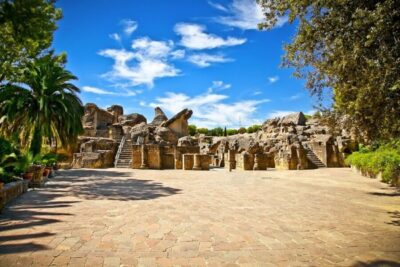
Visit to Italica Roman Ruins Tour tickets included
Read our review →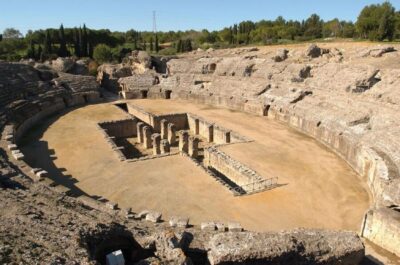
Private hald day tour to the historic roman city of Italica
Read our review →Browse the lists this tour appears in